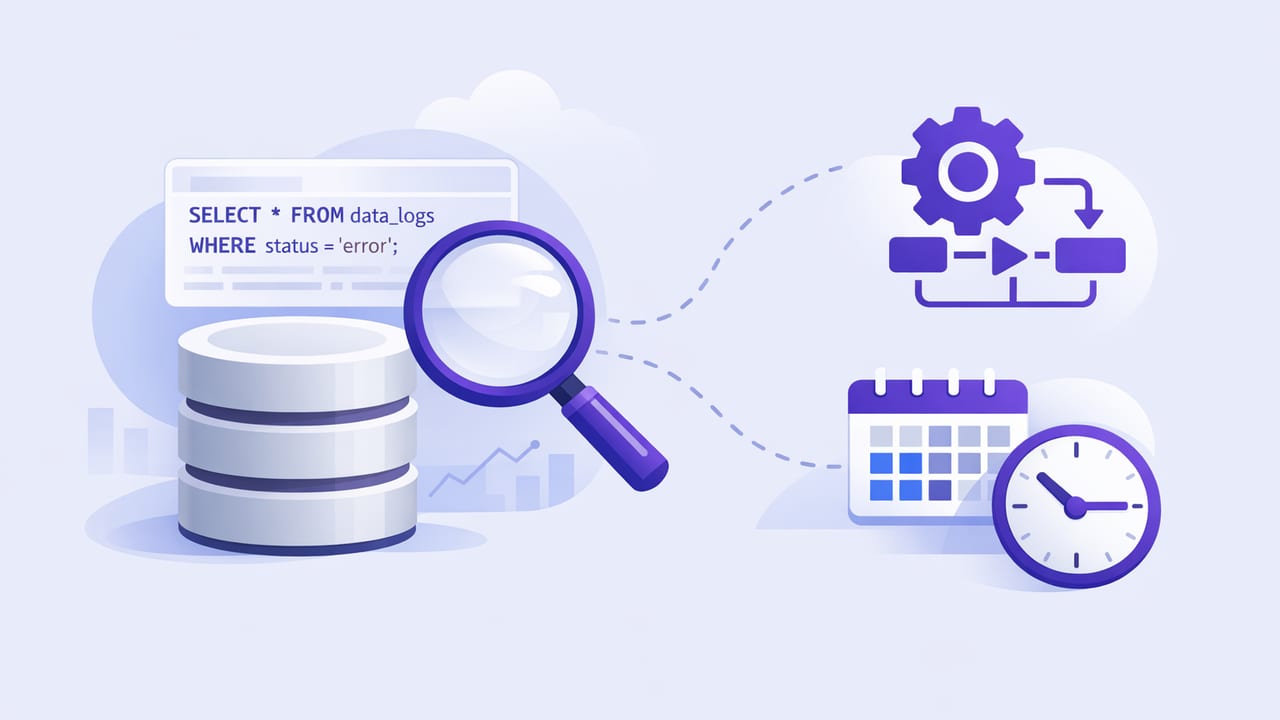
If you’re searching for an alternative to cron for SQL monitoring, you’re usually trying to solve a specific pain: cron-based scripts are easy to start with, but they become brittle, noisy, and hard to secure as monitoring needs grow. Modern data teams increasingly prefer event-driven or managed approaches that reduce operational overhead and improve alert quality.
This guide breaks down practical alternatives to cron for monitoring SQL databases (PostgreSQL, MySQL, and similar). You’ll learn when cron is still fine, where it breaks down, and which patterns are better depending on whether you need near real-time detection, simple scheduled checks, or auditable workflows.
Why cron-based SQL monitoring often fails in production
Cron itself is not “bad”—it’s a simple scheduler. The problem is using cron as a foundation for reliable monitoring and alerting without adding the pieces that production monitoring requires.
- Silent failures: a script can fail, hang, or get killed without a notification path you trust.
- No state management: deduping alerts (“only alert on change”) and tracking previous results becomes a homegrown persistence problem.
- Scaling pain: as checks grow from 5 to 50 to 500, you need concurrency control, retries, rate limits, and backoff.
- Security gaps: credentials stored on a VM, wide DB permissions, and unclear network boundaries are common.
- Time drift and missed runs: machine clocks, DST, deploys, and restarts can cause skipped schedules.
- Harder to get “near real-time”: running every minute is still polling—and can add avoidable database load.
As a rule: cron is a scheduler, not an alerting system.
A decision framework: what kind of “monitoring” do you actually need?
Before choosing a cron replacement, classify your use case:
- Event-driven changes: “Alert immediately when a row is inserted/updated” (inventory dips, suspicious logins).
- Data quality/threshold checks: “Alert if today’s orders drop below X” (scheduled, usually hourly/daily).
- Pipeline correctness: “Alert if a job didn’t write expected data by 09:00” (workflow + SLAs).
- Operational anomalies: “Alert on lock waits, replication lag, dead tuples” (often better handled by DB/infra monitoring tools).
The best alternative depends on whether you need push-based notification (event-driven) or poll-based checks (scheduled queries) and how much operational overhead you can tolerate.
Alternatives to cron for SQL monitoring
1) Database-native events (triggers + notifications)
If you want “alert on change” without polling, database-native events are often the cleanest solution. In PostgreSQL, a common pattern is TRIGGER + NOTIFY, with a consumer that uses LISTEN. This can reduce query load dramatically compared to “run a SELECT every minute.”
Pros: fast detection, minimal polling, precise scope (only fire on actual changes).
Cons: requires careful trigger design, can add write overhead, notification payloads are limited, and you still need a consumer process.
-- PostgreSQL: notify on inserts into a table
CREATE OR REPLACE FUNCTION notify_new_order()
RETURNS trigger AS $$
BEGIN
  PERFORM pg_notify('orders_channel', json_build_object(
    'order_id', NEW.id,
    'customer_id', NEW.customer_id,
    'total', NEW.total
  )::text);
  RETURN NEW;
END;
$$ LANGUAGE plpgsql;

CREATE TRIGGER orders_notify_trigger
AFTER INSERT ON orders
FOR EACH ROW
EXECUTE FUNCTION notify_new_order();
Your listener service (could be a small worker) consumes events and sends alerts (email, Slack, etc.). The key is that the database publishes events only when changes happen.
2) Change Data Capture (CDC) streams
CDC reads the database write-ahead log / binlog and emits a stream of changes. Tools and platforms in this category include Debezium, managed CDC in cloud providers, and streaming pipelines (often landing into Kafka or similar).
Pros: near real-time, doesn’t require triggers, scales well for many tables, great audit trail.
Cons: more moving parts (streaming infra), setup complexity, not always justified for a few simple alerts.
CDC is ideal when you want a consistent “stream of truth” and multiple downstream consumers (alerting, analytics, search indexing). For purely alerting use cases, it can be overkill unless you already run streaming infrastructure.
3) Managed schedulers (serverless) instead of OS cron
If your checks are inherently scheduled (e.g., “every 10 minutes”), you can keep polling—but move the scheduler out of your server. Managed schedulers reduce VM babysitting and improve reliability with built-in retries and observability.
- AWS: EventBridge Scheduler or CloudWatch Events + Lambda
- GCP: Cloud Scheduler + Cloud Run/Functions
- Azure: Logic Apps or Azure Functions with Timer triggers
Pros: no server to maintain, better retry semantics, integrates with secrets managers.
Cons: still polling, execution limits/timeouts, requires cloud IAM and networking setup.
This is one of the most common “cron replacements” because it retains the mental model of scheduled checks while addressing reliability and operations.
4) Workflow orchestrators for data SLAs (Airflow, Dagster, Prefect)
If your “monitoring” is actually “make sure the pipeline produced expected outputs,” a workflow orchestrator can be the right alternative. These tools excel at dependencies, backfills, retries, and surfacing task state.
Pros: strong observability, DAG-based dependencies, built-in retries and alert hooks, supports complex pipelines.
Cons: heavier footprint, can be too much for simple query alerts, operational overhead unless managed.
Choose an orchestrator when the question is “Did step X complete and write Y rows?” rather than “Did a row change?”
5) Job queues and workers (Celery, Sidekiq, BullMQ)
Another pattern is pushing checks into a job queue and letting workers execute them. Scheduling can be handled by a lightweight scheduler component (or the queue system itself), and the queue provides retries, concurrency controls, and dead-letter behavior.
Pros: scalable execution, robust retry/backoff, separates scheduling from execution.
Cons: you operate a queue/broker, you still need a scheduler, and alert dedupe/state is on you.
This option is especially good when checks are numerous and you need controlled concurrency to avoid hammering the database.
Comparison table: cron vs common alternatives
| Approach | Best for | Latency | Ops overhead | Key risk |
|---|---|---|---|---|
| OS cron + script | 1–5 simple checks | Polling interval | Low at first, grows fast | Silent failures, credential sprawl |
| Triggers + NOTIFY/LISTEN | Row-level change alerts | Near real-time | Medium | Trigger overhead, listener reliability |
| CDC stream | High-scale change monitoring | Near real-time | High (or medium if managed) | Complexity, streaming cost |
| Managed scheduler + serverless | Scheduled checks without servers | Polling interval | Low–Medium | Timeouts, networking/IAM setup |
| Workflow orchestrator | Pipeline SLAs and dependencies | Minutes+ | Medium–High | Tooling overhead for simple needs |
| Queue + workers | Many checks with concurrency control | Seconds–minutes | Medium | Broker ops, state/dedupe |
Designing safer SQL monitoring (regardless of scheduler)
Whichever alternative you choose, reliability and security come from the same fundamentals:
Use a read-only monitoring role
- Grant SELECT only to required schemas/tables/views.
- Prefer views that expose only what monitoring needs (avoid PII by design).
- For Postgres, consider
ALTER DEFAULT PRIVILEGESto prevent accidental access creep.
Make checks idempotent and dedupe alerts
A common anti-pattern: “If query returns any rows, send an email every run.” Better patterns:
- Alert only on state transitions (OK → FAIL and FAIL → OK).
- Track the last seen primary key / timestamp to alert only on new records.
- Add a cooldown window (don’t alert more than once every N minutes for the same condition).
Control load with query design
- Use selective indexes aligned to monitoring predicates.
- Prefer
EXISTSover counting whole tables when possible. - Set statement timeouts for monitoring queries.
Audit and observability
- Log each check: start time, duration, success/failure, row count, and a small sample of identifiers (not sensitive payloads).
- Emit metrics: p95 query runtime, failures per check, time since last successful run.
Example: converting a cron poll into a managed, deduped check
Imagine a basic cron job that checks for failed payments:
SELECT id, user_id, created_at
FROM payments
WHERE status = 'failed'
  AND created_at > now() - interval '10 minutes';
To make this production-friendly (even if you still poll), add:
- A checkpoint: store last successful run time (or last seen
id). - Dedupe: only alert on new failures since the checkpoint.
- Bounded work: limit results and page if needed.
-- Example pattern (Postgres): checkpoint by max(id)
SELECT id, user_id, created_at
FROM payments
WHERE status = 'failed'
  AND id > :last_seen_id
ORDER BY id
LIMIT 500;

-- After sending alerts, persist the new checkpoint as max(id) observed.
This pattern works well with managed schedulers, queues, or small worker services and avoids repeated alerts for the same records.
Choosing the right alternative to cron for SQL monitoring
- If you need immediate detection of row-level changes: start with triggers + notifications, or go to CDC if you need scale and broader reuse.
- If you need scheduled threshold checks and want to stop maintaining servers: use a managed scheduler + serverless execution.
- If your checks depend on pipeline steps and SLAs: use a workflow orchestrator.
- If you have many checks and need controlled concurrency: adopt a queue + worker model.
The most important shift is moving from “run a query periodically” to “design an alerting system”: state, dedupe, retries, and security boundaries. Once those are in place, the scheduler becomes an implementation detail.
Final note
If you prefer a lightweight approach for scheduled, read-only query checks with notifications—without standing up servers—some teams use mobile-first tools such as Query Alert to run database queries on a schedule and receive push/email alerts.