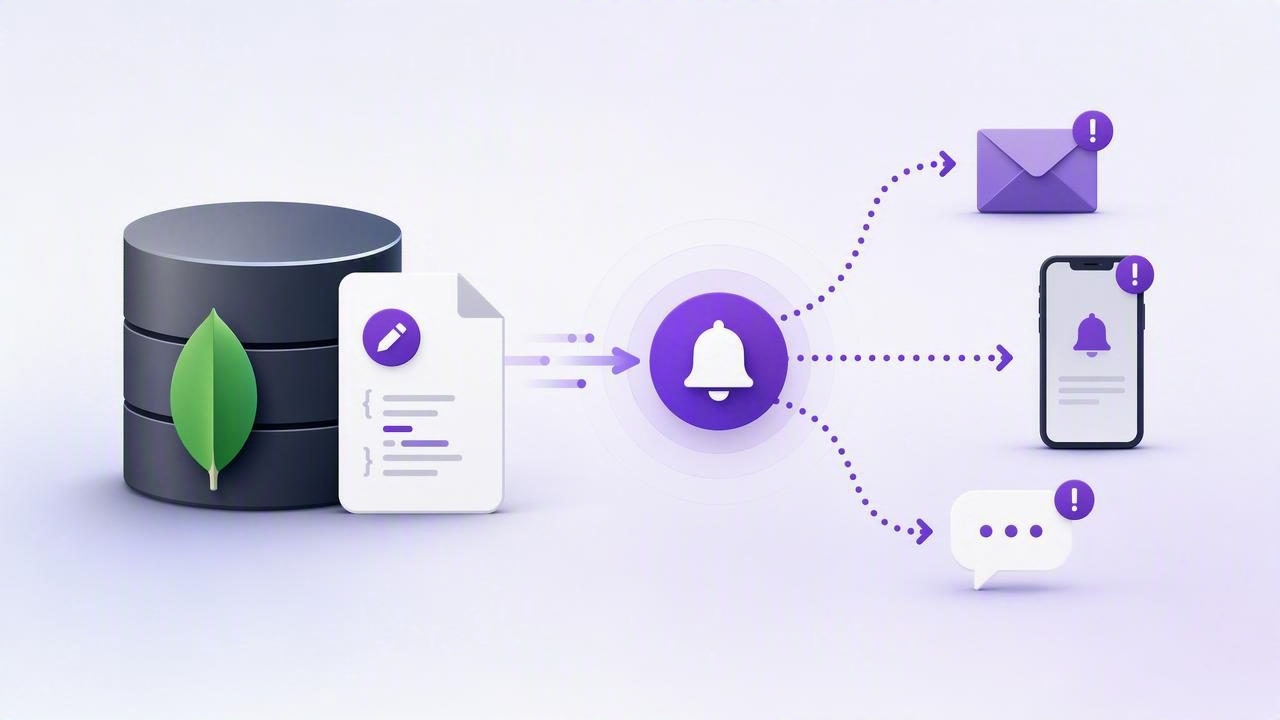
Teams often discover data problems too late: a customer record gets overwritten, an order status flips incorrectly, or a critical flag changes and nobody notices until users complain. If you want to receive alerts when mongodb document updated, you need a monitoring pattern that is accurate, secure, and operationally realistic for your stack.
This guide breaks down two reliable approaches—MongoDB Change Streams and scheduled polling queries—and shows how to design alerts that minimize false positives, avoid performance regressions, and keep credentials safe. You’ll also see practical code snippets and a checklist you can apply immediately.
What “document updated” really means (and what to alert on)
“Document updated” can mean many things in MongoDB:
- Any update to a document in a collection (high volume, often noisy)
- Updates to specific fields (e.g.,
status,role,isActive) - Updates matching business rules (e.g., status changes to
"failed", balance drops below threshold) - Updates to a specific document (by
_id) - Updates performed by certain actors (service account, admin tool, specific user)
Good alerts are precise. Aim to answer:
- Which updates matter?
- How quickly do you need to know? (seconds vs minutes)
- Who needs to be notified? (on-call vs analyst vs product)
- What context must be included? (before/after, actor, correlation IDs)
Rule of thumb: Alert on state transitions and threshold crossings, not raw update volume.
Two main approaches
| Approach | Best for | Latency | Operational cost | Common pitfalls |
|---|---|---|---|---|
| Change Streams | Near real-time alerts; precise event capture | Seconds | Requires a running watcher service | Resume tokens, reconnect logic, permissions |
| Scheduled polling queries | Simple checks; low ops; works without streams | Minutes (configurable) | Low to moderate (depends on schedule) | Missed edges, duplicate alerts, query load |
Option A: Use MongoDB Change Streams (near real-time)
Change Streams let you subscribe to changes (insert/update/replace/delete) in a collection, database, or entire cluster. They’re built on MongoDB’s oplog and are the most direct way to capture updates as they happen.
Prerequisites
- Replica set or sharded cluster (Change Streams require replication)
- A process that stays running (Node.js worker, Go service, etc.)
- Permissions to watch changes (principle of least privilege)
Example: watch updates on a collection (Node.js)
This example alerts on updates where status becomes "failed". It also demonstrates filtering and fullDocument lookup for context.
import { MongoClient } from "mongodb";

const uri = process.env.MONGODB_URI;
const client = new MongoClient(uri);

async function main() {
  await client.connect();
  const db = client.db("app");
  const col = db.collection("orders");

  const pipeline = [
    {
      $match: {
        operationType: "update",
        "updateDescription.updatedFields.status": "failed"
      }
    }
  ];

  // fullDocument: "updateLookup" fetches the latest full document
  const changeStream = col.watch(pipeline, { fullDocument: "updateLookup" });

  console.log("Watching for order status -> failed");

  for await (const change of changeStream) {
    const doc = change.fullDocument;
    const orderId = doc?._id;

    // Replace with your notification mechanism
    console.log("ALERT: order failed", {
      orderId,
      customerId: doc?.customerId,
      total: doc?.total,
      updatedAt: doc?.updatedAt
    });
  }
}

main().catch(err => {
  console.error(err);
  process.exit(1);
});
Make it reliable: resume tokens and reconnects
Production watchers must handle restarts and network blips. MongoDB provides resume tokens so you can continue from the last seen event. Store the latest token durably (e.g., a small collection or a secure KV store).
- Persist
change._id(the resume token) after processing each event - On restart, call
watch(..., { resumeAfter: token }) - Idempotency: ensure repeated events don’t produce duplicate alerts
Reduce noise with targeted matching
Instead of alerting on every update, filter on meaningful fields:
updateDescription.updatedFieldsfor specific changes- Namespace filters (only one collection)
- Actor filters (if you write
updatedByor similar metadata)
Option B: Scheduled polling queries (simple and safe)
If you can tolerate minute-level latency or you don’t want a long-running watcher service, scheduled polling is often the most practical approach. The idea is:
- Run a read-only query on a schedule (every 1–15 minutes)
- Compare current results to the last run
- Send an alert when a rule is met (new failures, unexpected changes, threshold exceeded)
Design polling so you don’t miss updates
The biggest polling mistake is querying “what changed in the last N minutes” using an unreliable timestamp. Fix that with one of these patterns:
- Monotonic updated field: maintain
updatedAtset by your application or database triggers - Version counter: increment
versionon each update - Append-only audit collection: write immutable change events (best for compliance)
Example polling query: find newly failed orders
Assume you store updatedAt and you keep the last checkpoint time (lastSeen). Query for anything updated since then:
// MongoDB shell / driver-style pseudo code
const lastSeen = ISODate("2026-02-01T10:00:00Z");

db.orders.find(
  {
    status: "failed",
    updatedAt: { $gt: lastSeen }
  },
  { _id: 1, customerId: 1, total: 1, updatedAt: 1 }
).sort({ updatedAt: 1 });
Important: store the new checkpoint as the maximum updatedAt you processed, not simply “now”, to avoid missing late writes or clock skew.
Indexing for low impact
Polling queries must be cheap. Add a compound index aligned to your filter and sort:
db.orders.createIndex({ status: 1, updatedAt: 1 })If you’re polling for a specific document by _id, you already have a performant path (default index on _id).
Security and governance: alerting without overexposure
Whether you use streams or polling, alerting often runs outside your main application. That creates risk: extra credentials, extra network paths, and potentially sensitive data in notifications.
Recommended security controls
- Read-only database user limited to the required database/collection.
- TLS everywhere (MongoDB URI with TLS settings; verify certificates).
- Minimize data in alerts: include identifiers and summary fields, not full PII.
- Encrypt secrets at rest (Keychain/Secrets Manager) and rotate them.
- Auditability: log when alerts are triggered and by which rule, without logging sensitive payloads.
Data minimization example
Instead of sending the entire changed document, send:
- Document ID (
_id) - The triggering condition (e.g.,
status: failed) - Timestamp and environment (prod/staging)
- A link to an internal dashboard for deeper inspection
Alert quality: deduplication, thresholds, and routing
Even accurate change detection can produce bad alerts if you don’t control volume.
Deduplicate repeated updates
- Use an idempotency key like
{_id, updatedAt}or the Change Stream event id. - Suppress repeated alerts for the same entity within a cooldown window.
Use thresholds for noisy signals
For example, alert only when failures exceed a rate:
// Aggregation idea: failures in last 5 minutes
db.orders.aggregate([
  { $match: { status: "failed", updatedAt: { $gt: new Date(Date.now() - 5*60*1000) } } },
  { $count: "failedCount" }
])
Then alert if failedCount crosses your threshold, rather than alerting per document.
Route alerts by urgency
- Push/on-call: security-related updates, payment failures, data integrity issues
- Email: daily summaries, non-urgent drifts
- Ticketing: recurring issues that need ownership and tracking
Choosing the right approach (quick decision guide)
- Pick Change Streams if you need near real-time detection, you can run a small watcher service, and you want precise event capture.
- Pick Polling if you want a simpler operational model, minute-level latency is acceptable, and you can write efficient indexed queries.
- Consider a hybrid: streams for critical collections, polling for low-priority checks and aggregate metrics.
Practical checklist
- Define the rule: which collection, which fields, what constitutes “important”.
- Decide latency: seconds (streams) vs minutes (polling).
- Make it cheap: add the right indexes; keep projections small.
- Make it safe: read-only credentials, TLS, minimal alert payload.
- Make it reliable: resume tokens (streams) or checkpoints (polling).
- Control noise: dedupe keys, cooldown windows, thresholds.
Putting it into practice
If you’re implementing this yourself, start by choosing one high-value alert (e.g., status transitions to failed), ship it end-to-end, and then expand. The fastest wins usually come from a small set of business-critical updates with clear ownership and a defined response playbook.
For teams that prefer configuring scheduled MongoDB checks and receiving notifications on mobile without building a watcher service from scratch, tools like Query Alert can provide a structured way to turn read-only queries into alerts while keeping connections encrypted.